

Thinking Slow, Beyond Slop
A meditation on our relationship with technology.

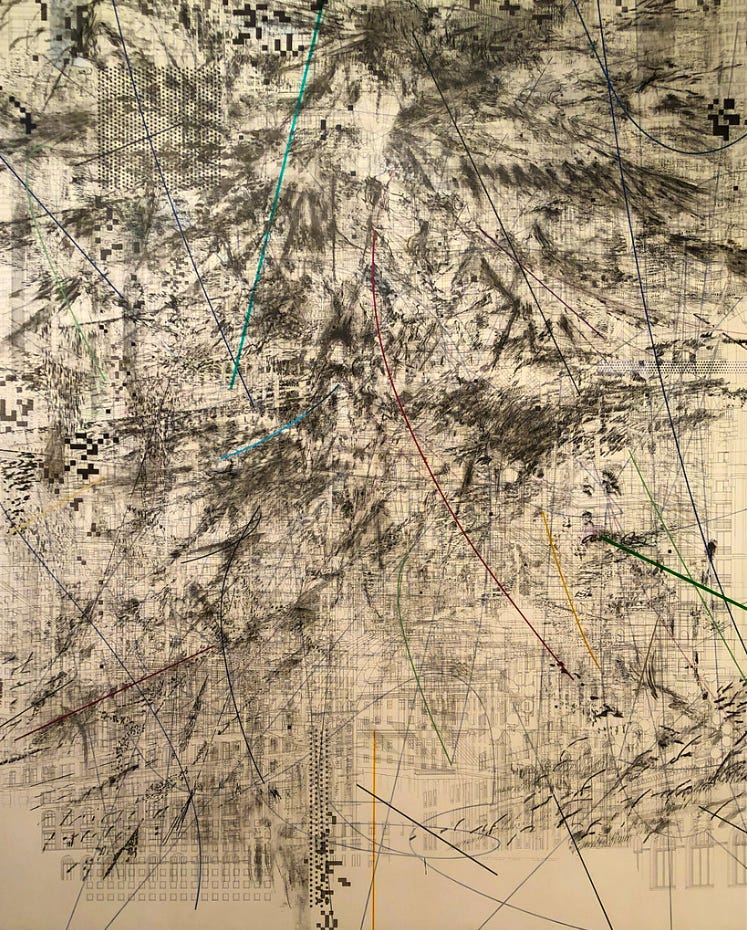
Slopworld
The internet began as a cathedral for curiosity. Search used to mean finding something unexpected; now it implies getting the most probable answer before you’ve even finished asking. The comfort of prediction has replaced the adventure of thought.
The web democratised access to information; now AI has democratised access to content generation. This platform shift in technology has given us incredible tools to write, create film, compose music, and generate images. We are empowered beyond belief to create, build, and share our work. But it’s also enabled ‘slop’- the synthetic slurry of mass-produced, low-context content - to infiltrate our collective mindshare.
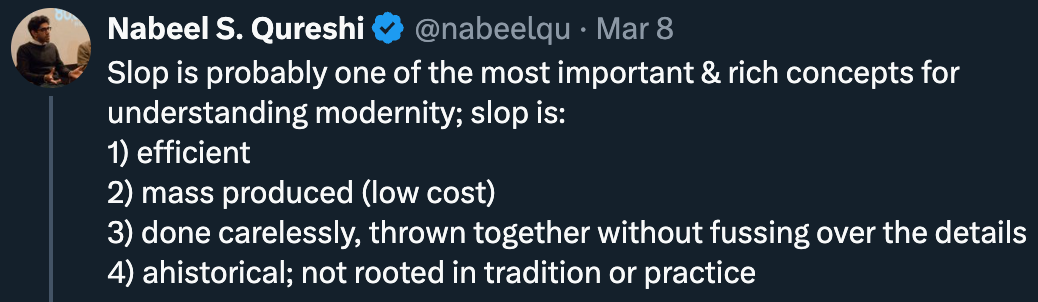
‘Slop’ is not confined to social media; we see it in fast food, fast fashion, and even fast furniture (IKEA). But its role in our digital lives is most corrosive. Our feeds scroll forever, our minds numb to context. Memory is formed through narratives and stories, but social media presents us with fragmented, alarming information instead. We’ve replaced memory with feed history and wonder with refresh.
As the writer Gurwinder shares in his seminal piece:
“Your social media feed resists emplotment because it’s the opposite of a story. It’s a chronological maze. It has no beginning, middle, or end, and each post is unrelated to the next, so that scrolling is like trying to read a book in a windstorm, the pages constantly flapping, abruptly switching the current scene with an unrelated one, so you can never connect the dots into a coherent and memorable narrative…We have no problem recounting the plot of a good book we read or movie we saw last year, yet we can barely remember what we saw on social media yesterday.”
The goal is no longer to inform you, but to capture you. Our feeds curvilinear, with no ‘perpendicular turns’ to make us pause to understand the depth of time that has passed. We are lured into passivity. Haven’t you noticed, even GPT now ends each prompt with a question begging for a follow-up?
The Search for Meaning
“If you are not paying for the product, you are the product.” – Tristan Harris
We drink from the proverbial firehose of information, but refrain from engaging in the intellectual exercise of determining what is factual or forged. Our attention is frictionless and wandering, our judgment atrophied. We fall into cognitive drift: not that people believe false things, but that we’ve lost the tools to tell what is true at all.
As Jon Stewart put it, social media is “ultra-processed speech”; speech in the way that Doritos are food. It’s language optimised for sensation, not reflection; crafted to slip past the parts of our mind that once filtered what mattered.
It’s not just the quantum of information, but what is being promoted. Social media platforms prioritise engagement, not the truth. Engagement is rarely driven by positive news, but rather by falsehoods or provoking media. The design of these platforms is based on evolutionary psychology: the variable reward schedule and unpredictable nature of posts mimic slot machines, the red notification acts as an ‘urgent’ colour to seek our attention, and every ‘like’ feels like a dopamine reward, eventually desensitising our motivation engine.
This idea is not new. In her book on casino design, Schüll shares that the goal of a casino is to shepherd players into the “machine zone”: a state of mind where they don’t play to win; they play to keep playing, to enter a dissociative state where time, money, and self blur. Our feeds mimic the same mechanics.
Not surprisingly, Slopworld, with the added incentive of spreading falsehoods, paints a bleak picture. The rebirth of discernment stems from taste, as well as filters of coherence. Being passive as we enter the next wave of information generation is a recipe for a docile thinking pattern. Our hunter-gatherer minds were not built for the sensory tsunami we drown ourselves in before breakfast. There has to be a better way.
Earned Wisdom
The moving train of slop will not be stopped, but only refuelled. Surviving the technocalypse is not contingent on halting the train, but on strengthening the passenger. It requires individual work; being aware, being proactive, and protecting the climate within our skulls.
The antidote to fighting slop is not curation, but the cultivation of discernment. In a world where everything is available instantly, wisdom is found in the pace at which we choose to understand. Slow knowledge becomes a form of resistance. Gathering pebbles of context and building independent opinions of the world, rather than waiting for feeds to educate us.
As slop proliferates and the costs of anonymity become clear, there will be a march towards identity and a deep desire for verification of where information flows from. Cryptographic proof will take on a new role. A move to private, intimate gatherings will become more powerful as a mechanism to filter, and large conferences will continue their trudge to low status. We’re already seeing small signals of this shift: the rise of prediction markets as trusted information beacons, where incentives force accuracy rather than virality. Taleb’s insistence on skin in the game and Munger’s reminder that incentives shape behaviour remain perennial truths.
The answer might lie in stepping away. Sensitivity is lost in excess, and for some, an escape to nature like Thoreau narrates in ‘Walden’, a meditation retreat, or a digital sabbath from our devices. We might wish to change our devices altogether, moving towards new-age, ‘focus-first’ products. I am a work in progress in this fight, but one thing is clear: we must move with intention, because the enemy isn’t distraction, it’s entropy.
Thank you to Rahul Sanghi of Tigerfeathers for reading and editing my drafts.
Resonate with your thoughts, it extends beyond slop - being mindful of what we consume in life. I like the concept of focus first products but they will remain niche.. can't get myself to spend $500 on a 'dumb device' yet